AU-EU summit: Europe shifts from security governance to transactional economics in Africa, but at what investment risk?
 BEYOND BUSINESS AS USUAL SERIES
By Guillaume Lacaille, Senior Associate at TrustWorks
The European Union’s flagship Global Gateway strategy, a €300 billion investment plan by 2027, focuses overwhelmingly on economic projects—trade corridors, renewable energy, digital infrastructure—rather than on the thorny, politically sensitive work of security sector reform (SSR). Brussels has chosen to focus on what it can control: trade and infrastructure, areas where African governments are eager partners and European companies stand to profit. By sidestepping the structural weaknesses of many African security services, the EU is creating a paradox: it invites businesses to pour billions into trade corridors, energy projects, and digital networks, while leaving those investments vulnerable to the very risks to stability it renounces to address.
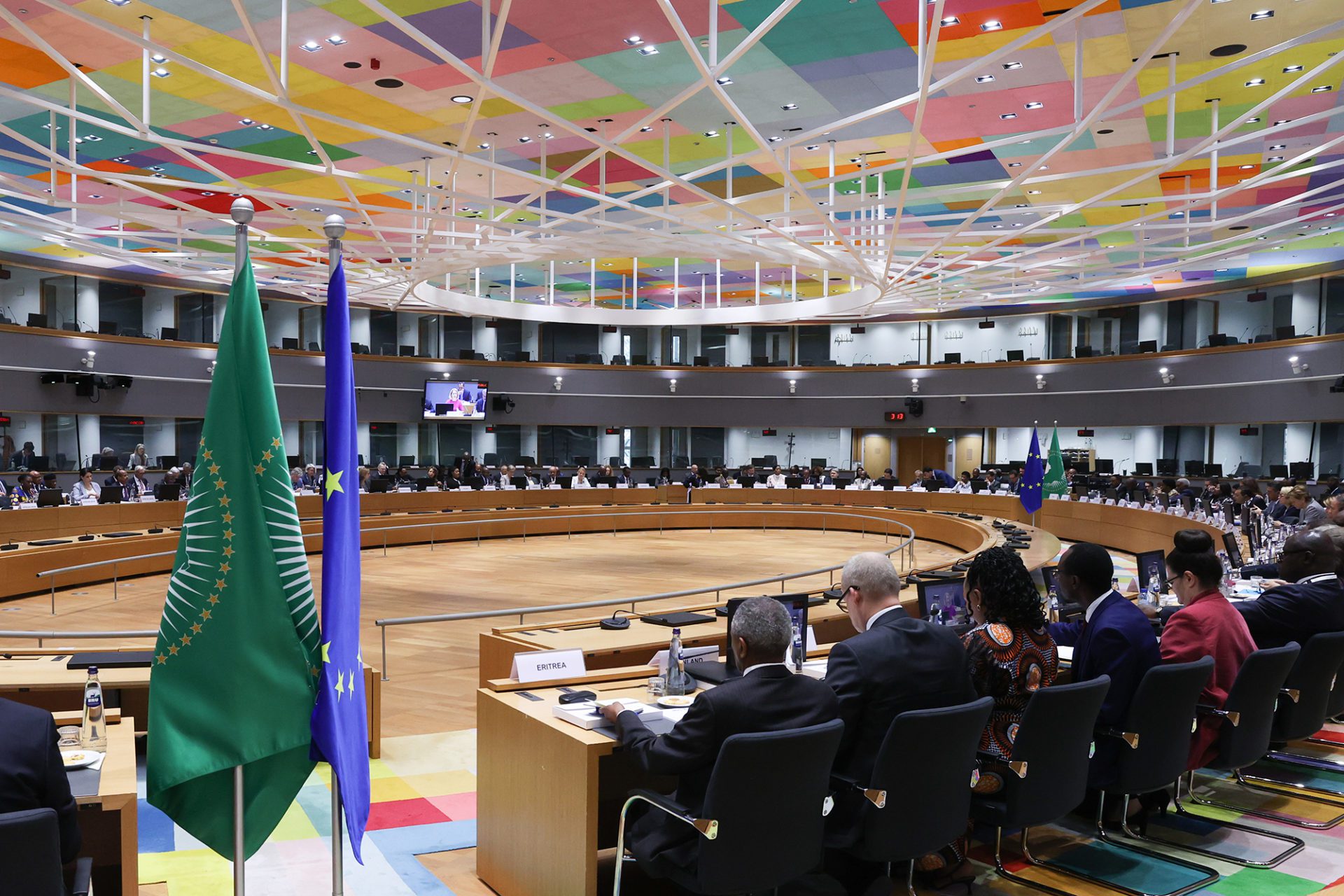
Luanda, Angola — 24 – 25 November 2025 — During the recent African Union-European Union summit, European leaders quietly buried an era. For 25 years, since the shock of 9/11, western powers had revamped their international assistance towards statebuilding objectives in fragile and conflict-affected situations (FCAS). For more than 10 years, since the launch of the French military Operation Serval in Mali in January 2013, the EU has pursued an ambitious, if flawed, strategy in Africa: combining security assistance, governance reform, and development aid to build stable, democratic states. But after repeated failures—especially in the Sahel—Brussels has now adopted a new, far less demanding approach. No more lectures on human rights or institutional reforms. No more grand plans for regional security cooperation. Instead, the EU will focus on what African governments actually want: money for infrastructure, equipment for their armies, and no strings attached.
This new direction, presented as a pragmatic recalibration, is in fact a retreat. It reflects not just the shift of EU’s assistance assets towards responding to the war in Ukraine, but also its reluctance to confront the deeper reasons for its failures in Africa. The lessons learned exercises conducted in Brussels following the series of military coups in Sahel resulted in discounting overly ambitious approaches that had been undermined by the inherent difficulties in integrating and coordinating different types of actions. But by shelving the whole approach, the EU is avoiding the hard questions about why its dialogue with African leaders on security sector governance has so often fallen short—and whether the European support package to African security institutions has ever been calibrated to the right needs and priorities. Too often EU priorities failed to support or reflect the outcomes of a genuine dialogue with partner states and their institutions.
Since European resources and the political capital required to induce systemic transformation and major governance improvement in African security institutions are now in short supply, an area where EU assistance could still make a difference and contribute to important structural changes is in information management. Providing African decisionmakers with the modern systems to exploit data on the real performance and impact of the military and police forces often operating at a distance from the national capital would allow for a more acute picture of the situation in the field, better operational and strategic decisions, and ultimately a gradual adaptation of the security sector to a new result-based culture. This new culture would be the best vehicle to demonstrate the benefits of transparency and accountability as building blocks for good governance.
The Luanda Summit: The end of an ambition
At the AU-EU summit in Luanda, the message was clear: transforming national security systems is no longer a priority. The EU’s flagship Global Gateway strategy, a €300 billion investment plan by 2027, will now focus overwhelmingly on economic projects—trade corridors, renewable energy, digital infrastructure—rather than on the thorny, politically sensitive work of security sector reform (SSR). Brussels has chosen to focus on what it can control: trade and infrastructure, areas where African governments are eager partners and European companies stand to profit.
But this new approach is not just about pragmatism. It is also about avoiding (re)opening the sensitive debate about the pertinence of compelling beneficiaries of EU assistance to embrace the European models, norms and values promoted through the previous EU-funded initiatives that have supported the security sector of many African partner-countries.
Instead of taking stock and rethinking the approach to good governance in the security sector, the EU has chosen to scale back. SSR is now treated as a box-ticking exercise, a legacy obligation rather than a core priority. A good illustration is provided by the embarrassing silence that welcomed the poor review of the implementation of the existing EU SSR policy (the 2016 ‘EU-wide strategic framework to support SSR’) that was released in July 2025. In Luanda, European leaders preferred to highlight the European Peace Facility (EPF), a tool that allows for the rapid financing of military equipment under a classic “train & equip” approach—without the messy business of looking into the political economy of the military, police, and justice organisations that the EU is supposed to help reform.
Pragmatism as an excuse: Delivering equipment, not doing the heavy lifting
In a nod to reduced resources and influence, and stiff competition on the continent from other partners, the EU appears poised to be much more demand driven in offering its assistance with few strings attached. In practice, this means equipment, operational training, and funding for infrastructure projects—roads, ports, power plants—without preconditions. This approach is framed as “respecting national sovereignty” when security assistance partners like Russia, China, Türkiye and the Gulf countries are offering alternatives options.
This pragmatism comes at a cost. By focusing on localized actions—such as securing trade corridors—the EU sidesteps the structural causes of instability that require a more integrated approach: weak institutions, mismanagement in public service delivery and the lack of public trust in security forces. Worse, it leaves these issues to a few United Nations’ specialised agencies and civil society organisations that have themselves not sufficiently questioned their outdated intervention models, and whose budgets are also being cut by donors.
This narrow focus carries significant risks—not just for stability in Africa, but also for the private sector that the EU is courting to invest on the continent through its Global Gateway projects. By sidestepping the structural weaknesses of many African security services, the EU is creating a paradox: it invites businesses to pour billions into trade corridors, energy projects, and digital networks, while leaving those investments vulnerable to the very risks to stability it renounces to address. Inefficient, ineffective and unaccountable security institutions do not just threaten peace—they undermine the rule of law, contract enforcement, and the predictable business environments that private investors demand.
Big bang for your buck: Information management, not just drones and intelligence
In the early 2010s, interventions across Sahel emerged as “laboratories” where the EU and its Member States tested their methods in supporting SSR at a large scale, following years of mixed results in supporting SSR in central African states. In 2012, EUCAP Sahel Niger was set up with police personnel seconded by EU Member States under the EU’s Common Security and Defence Policy (CSDP) to build the capacity of Nigerien security forces in tackling irregular migration. Complementing the French counter-terrorism Operation Serval, the EU successively launched military and civilian CSDP missions in Mali. It also established the EU Emergency Trust Fund for Africa in November 2015, which, together with other financial instruments, channelled hundreds of millions of euros for security-related projects.
The EU missions struggled to meet the complex challenges facing them. As SSR experts strove to craft a convincing message about why addressing governance issues was critical to reinforce the effectiveness of the security sector in Sahel, the police and military professionals seconded by EU Member States to CSDP missions—often drawn from traditions ill-suited to local contexts—kept replicating conventional models with little adaptation to local realities. By the time of the Luanda Summit, the retreat by most European actors from these fields was evident with only EUCAP Sahel Mali remaining.
Nowadays, African political and security leaders not only crave modern equipment; like any high-level managers from organisations operating in a constantly changing environment, they also seek the ability to autonomously analyse security dynamics, monitor the effects of national responses, and learn from mistakes and regional best practices.
In recent years, the EU and its Member States have maintained—if not increased—cooperation with select African partners in the areas of intelligence and crisis management. For instance, the EU and Belgium joined forces to set up a crisis coordination centre under the Head of Police in Benin in 2020, and Western and Ivorian intelligence services worked well together to secure the 2023 Africa Cup of Nations in Côte d’Ivoire. While these specific efforts linked to the effective exploitation of information are important, the whole field of information management for security institutions—the practice of collecting, organizing, storing, and using information to meet organizational goals—is still underdeveloped in countries in FCAS.
The mainstreaming of modern information management practices across the security sector is one area of EU intervention and assistance that remains promising – for both its win-win proposition between donors and recipients and its potential for high return on modest investments. Developing together the innovative decision-making tools that focus on strategic foresight and evidence-based policy design—like executive dashboards, scenario planning or citizen engagement platforms— would facilitate the direction of security initiatives and the sharing of valuable information among partners.
Many senior officials from police, military and justice institutions, as well as in the ministries and oversight bodies are currently looking into ways and partners to boost their ability to make decisions based on reliable, pertinent and well-presented evidence, data, statistical analysis and best practices. This objective requires revising working and reporting processes, with the side effects of eliciting more transparency and accountability, leading to better governance. Yet rare are the specialists with the relevant experience gained in the public or private sector who are supporting such complex—and politically sensitive—structural transformation.
The solution? Allowing African governments to select the most competent international service providers and allocate resources to leverage private-sector expertise in information management to deliver tailored services, addressing specific priorities identified through a thorough dialogue and needs assessment.
Conclusion: A missed opportunity?
The Luanda summit marks the end of an era. The EU has given up on its aspiration to reshape African security governance in its own image. Instead, it seems to settle for being an economic partner, delivering equipment and funding without demanding change. This may appear less politically risky, but it is also less responsible.
This paradigm shift in governance should not mean abandoning all claims to encourage systemic transformation in the security sector. With lucidity and ambition—by involving the private sector for both its complementary skills and common interest in mitigating risk and uncertainties—, the EU still has opportunities to recalibrate its security assistance, rather than give up, so that doubling down on investment is not wasted.